

BRAIN & BIKE NEWS
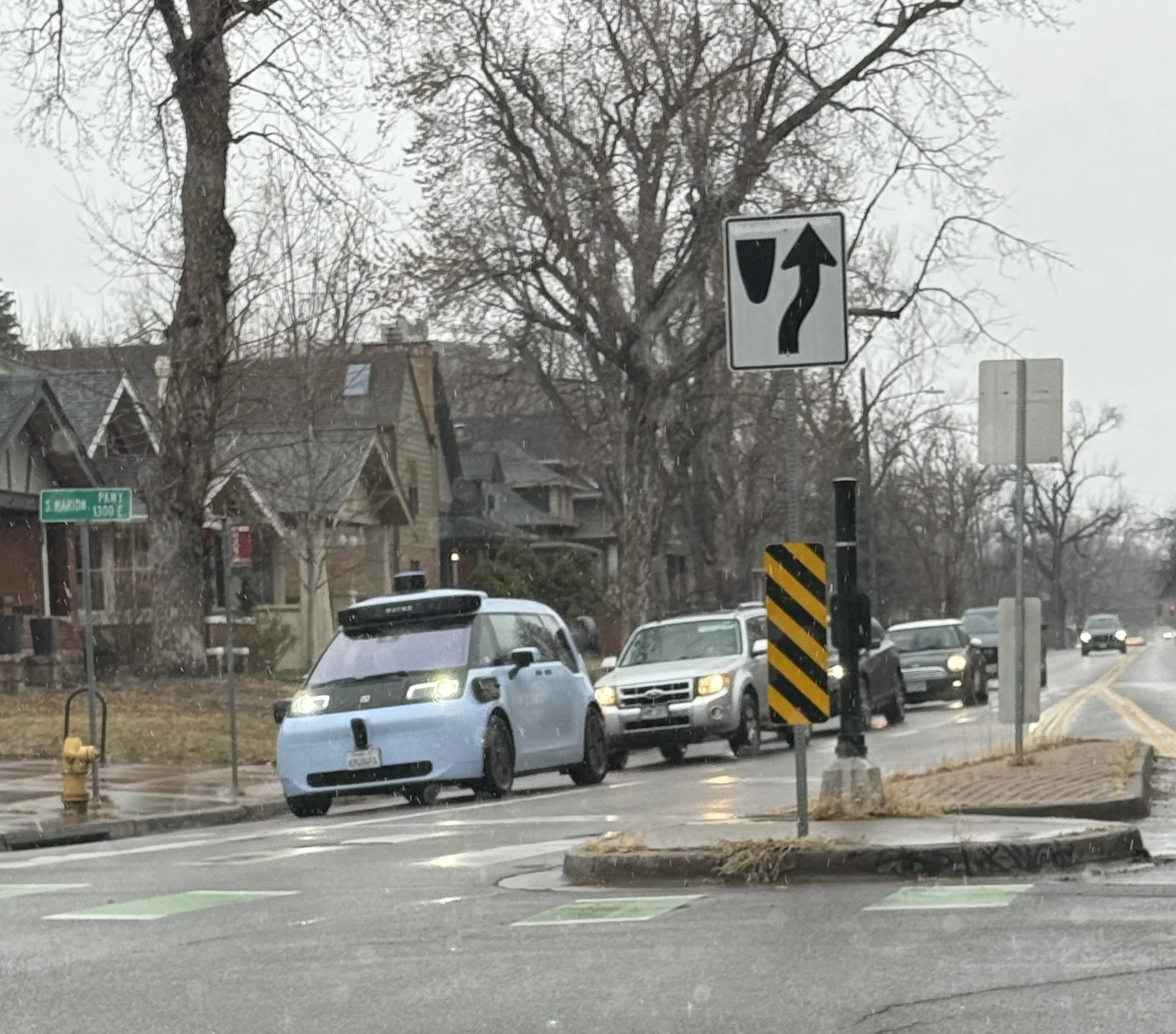
Waymo in Denver
Yes, Waymo is operating in Denver, Colorado now.
Yes, Waymo is operating in Denver, Colorado. If you haven’t seen them already driving around Denver, it’s only a matter of time before you see the driverless taxis with the distinctive black sensor “hat” on the roof making their way around Denver. There are a couple different Waymo vehicles. Some are a white Jaguar SUV and another type is a small Zeekr van, which is baby blue or blue silver in color.
Waymo is an American autonomous driving technology company, and is a subsidiary of Google's parent company, Alphabet, Inc. Waymo vehicles are driverless and use AI and cameras, radar, and LIDAR to navigate streets. To hail a Waymo vehicle, request a ride with the Waymo app, much like you would do for Uber and Lyft. Waymo has been in Denver since September mapping and testing out its vehicles with drivers, but the public can’t get in one quite yet in Denver. The plan is sometime in early 2026 that you can get a Waymo in Central Denver.
Waymo claims to improve convenience and safety compared to human drivers, but will Denver’s winter road conditions pose a greater challenge for these driverless vehicles? With an unseasonably warm start to the winter weather driving season there hasn’t been many opportunities to test these autonomous vehicles in winter driving on Denver’s streets. However, we may soon find out more real-world data as Denver braces for only its second snow storm of the season starting this January 8, 2026. Stay tuned and watch for these distinctive vehicles on a Denver street near you.

Will there be a new TBI classification system in the near future?
There are shortcomings to the current TBI grading system because it does not consider other factors relevant to patient outcome. In 2025, a new TBI classification framework called CBI-M was announced and is starting trials in trauma centers. This proposed new model will use clinical, biomarker blood tests, imaging, and modifiers based on the patient’s individual factors like existing medical conditions, environmental factors, and how the injury occurred. It’s unclear what labels this new CBI-M framework may assign for severity as it will likely go through further refinement and validation.
The current classification of traumatic brain injury severity falls into three general categories or classifications known as: (1) Mild; (2) Moderate; and (3) Severe. There is no uniform definition. While multiple professional organizations use different definitions and sometimes conflicting criteria, a TBI generally depends on duration of loss of consciousness, length of post-injury amnesia, Glasgow Coma Scale score, or presence of intracranial abnormality. Within each category exists a range. For example, loss of consciousness for the mild category is 0 to 30 minutes, the moderate category greater than 30 minutes up to 24 hours, and the severe category is greater than 24 hours.
There are shortcomings to this grading system because it does not consider other factors relevant to patient outcome. As a result, there is a strong desire in the medical and scientific communities to move away from the current model of mild, moderate, and severe. In 2025, a new TBI classification framework called CBI-M was announced and is starting trials in trauma centers. This proposed new model will use clinical, biomarker blood tests, imaging, and modifiers based on the patient’s individual factors like existing medical conditions, environmental factors, and how the injury occurred. It’s unclear what labels this new CBI-M framework may assign for severity as it will likely go through further refinement and validation.
The desire to move away from these simple labels recognizes that the current severity ratings are not necessarily an accurate reflection of the severity of the effects a brain injury has on a person’s functioning or the outcome for a person. Mild doesn’t mean the consequences are mild. Instead, a mild TBI can have very serious and debilitating life changing consequences that permanently interfere with work and enjoyment of life.
As the science surrounding TBI continues to evolve, understanding these complexities and changes are important for proper diagnosis, treatment, rehabilitation, and protecting the legal rights of brain injury victims. We are committed to working with expert doctors in the field of TBI and staying informed about the latest brain injury science to protect our client’s rights.
If you have any questions or would like to learn more about our legal services and how our focus in brain injury and bicycle injury cases matters, please get in touch with us via our contact page at Contact Us.
If you found this post helpful, you might also like to explore the other topics listed below and the many other topics in our comprehensive Safety & Prevention Guide, Brain Injury Guide, and Bike Injury Guide.

New Colorado laws to know about for 2026
New Colorado laws effective January 1, 2026 relevant to Bike and Brain Law.
Starting January 1, 2026, there are a few new Colorado laws in effect applicable to bike and brain injury law.
HB25-1197 changes Colorado Revised Statute § 42-4-221 to require manufacturers of electric assisted bicycles to label the e-bike with the highest class which the e-bike is capable of operation, and prohibits false labeling. The law clarifies that vehicles are not electrical assisted bicycle if the vehicle is modified so that it no longer meets the requirements for an electrical assisted bicycle class or a vehicle that is designed, manufactured, or intended by the manufacturer or seller to be easily configured so as not to meet all the requirements of an electrical assisted bicycle class. The act also defines "multiple mode electrical assisted bicycle" to account for electrical assisted bicycles that are capable of switching between different classes.
HB25-1179 changes Colorado Revised Statute § 10-4-644 to require car insurance companies to include the replacement cost of a car seat or other restraint system in the vehicle at the time of a crash.
Bike Brain Law launches website to help victims of bike crashes and brain injuries find answers and a lawyer
In an era of information overload, navigating the multitude of personal injury attorney advertisements on billboards, television, and online, finding the right personal injury attorney to help with a brain injury or bicycle crash case can be a daunting task. That’s why Attorney Dan D’Angelo designed Bike Brain Law’s website to help Colorado bicycle crash and traumatic brain injury victims easily find the resources necessary to learn about brain and bicycle injuries, and how to find a trusted and experienced lawyer in brain injury and bicycle crash cases.
Due to the unique and invisible nature of a brain injury, Brain Injury Victims often have many questions about their life-altering injury, don’t know where to turn for help, and face deep skepticism from insurance companies. Traumatic brain injuries are complex medical and legal cases that require specialized knowledge. Brain injury cases often involve lifelong physical, cognitive, emotional, and behavioral changes that can severely impact a person’s quality of life and their ability to work, resulting in significant damages. Hiring the right attorney with experience handling brain injury cases is important for recovering the full and fair damages caused by such a complicated and unique injury.
Bicyclists are vulnerable to serious injury from distracted and aggressive drivers to corporations that sell unsafe bicycles by putting profits over safety. Bicycle injury cases are also unique and require specialized knowledge about bicycle and consumer protection laws, bicycle technology, and safety standards that apply to bicycle manufacturers. As a passionate cyclist, Attorney Dan D’Angelo has observed or experienced the reckless driving that often causes serious injuries to cyclists. We know bikes, and our knowledge of bicycle laws, design, maintenance, and assembly give us an advantage in bicycle crash and bicycle product liability cases.
Brain Injury Victims and Victims of Bicycle Crashes need a trusted and experienced lawyer to navigate the difficult road ahead. As a trusted legal advocate for brain injury victims and injured cyclists, Attorney Dan D’Angelo provides extensive experience and unwavering support to lead the way when the road ahead looks daunting. We hold the accountable parties responsible and improve community safety. Since 2009, we’ve handled traumatic brain injury and bicycle crash cases and recovered millions for our injured clients so they can rebuild and reclaim their lives.
With our extensive experience handling brain injury and bicycle crash cases, we’ve built the Bike Brain Law Resource Hub and FAQs to provide comprehensive information and guidance to Brain and Cycling Injury Victims, enabling them to get the answers and access to legal representation they need and deserve.
If you have any questions or would like to learn more about our legal services and how our focus in brain injury and bicycle injury cases matters, please get in touch with us via the contact page on our website at Contact Us or call us for free at 303-831-1116.
To learn more about brain injuries and bicycle crash cases we handle, continue to explore the FAQs, the Bike Brain Law Resource Hub and the Brain Injury Guide, Bike Injury Guide, and Safety & Prevention Guide on our website.